
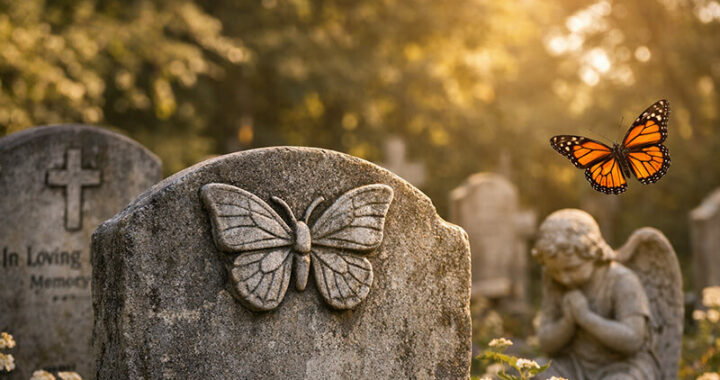
🦋 What Does a Butterfly on a Headstone Mean?
A quiet symbol with a powerful message — carved in stone, remembered forever.
📋 Table of Contents
- 1. Origins of the Butterfly Symbol
- 2. Core Spiritual Meanings
- 3. Across Cultures & Religions
- 4. Real-Life Examples
- 5. Facts & Evidence
- 6. Common Abbreviations in Gravestone Studies
- 7. Final Thoughts
1. Origins of the Butterfly Symbol
Strolling through an old cemetery, you might spot some fine butterfly motifs carved in granite and marble. Yet these are not mere decorative elements, the butterfly has been a very potent symbol for thousands of years. Ancient Egypt was not the only place where the butterfly stood for the soul’s journey after death; from Egypt to Victorian England, it was a widely used symbol it was a widely used symbol of the soul’s journey after death.
Here is a fact: Even the ancient Greeks considered the butterfly as spirit/soul because that was the meaning of the word psyche (ψυχή). By the way, you can still find paintings of butterflies on the tombs of Greek people up to two hundred years before Christ.
2. Core Spiritual Meanings
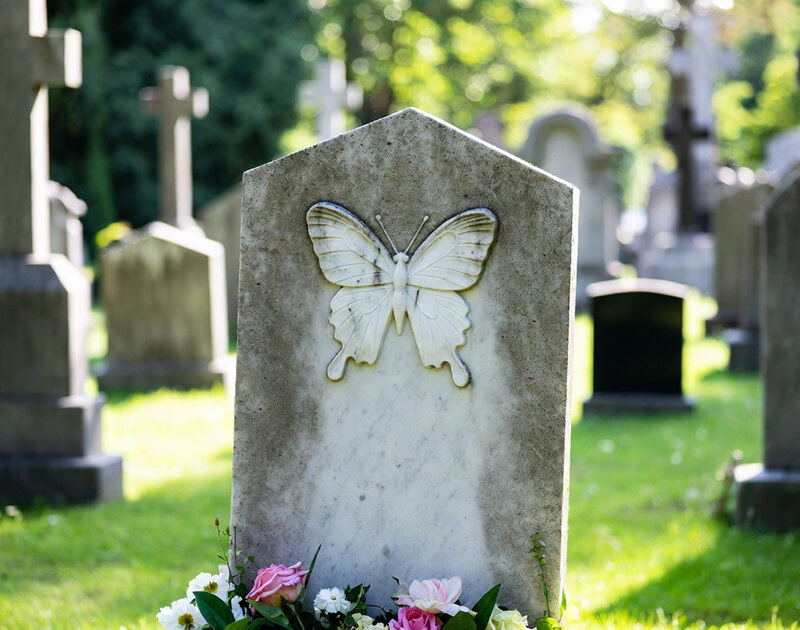
Why is a butterfly still placed there? In fact, butterflies depicted on graves represent more than just the little insects; in most cases, they symbolically refer to one of the following ideas:
- Resurrection & new life — Just as a caterpillar transforms into a butterfly, the soul is believed to begin a new existence.
- Hope — The butterfly suggests that the deceased has not truly died, but has undergone a transformation.
- Innocence — Especially on children’s graves, where fragile wings stand for a pure, short life.
- Freedom, the soul is set free from earthly suffering and pain.
“The butterfly does not remember being a caterpillar. Perhaps the soul does not remember being a body.”, Rev. Thomas Hargreaves, Symbols in Sacred Spaces, 1998
3. Across Cultures & Religions
The meaning of a butterfly headstone differs slightly by tradition:
- ✝ Christian tradition The butterfly is a symbol of the resurrection of Christ. The three stages of caterpillar, chrysalis, butterfly refer to life, death, and resurrection. That is why the butterfly image is very common on 19th-c. Christian gravestones in the UK and US.
- ☯ Chinese & East Asian tradition In Chinese culture, two butterflies together signify love that lasts forever. One butterfly on a tomb might represent the spirit of the deceased coming to visit the living.
- 🪶 Native American tradition In many tribes the butterfly is a symbol of the messenger who brings the prayers of the living to the spirits of the dead.
4. Real-Life Examples
🌿 Highgate Cemetery, London
A number of Victorian tombstones at Highgate Cemetery, London are decorated with carved butterflies in addition to the I.L.M. inscription. Grief historian Dr. Eleanor Marsh, in a 2017 paper, pointed out that butterfly illustrations on tombs from 19th century England noticeably rose after the death of Prince Albert in 1861, as mourning practices became more elaborate.
👶 Case: Emma Louisa Webb (1881, 1884)
At the St. Mary’s churchyard in Gloucestershire, the tomb of three-year-old Emma Webb is marked by a large marble butterfly. As her parents could not afford a fancy monument, they relied solely on the butterfly symbol to express the idea of the brief and innocent life of their child. Our local historians say that from an emotional point of view, it is probably the most straightforward memorial in the whole southwest region.
🪖 Military graves, WWI
According to CWGC, there were instances when family-commissioned tombstones for soldiers fallen in WWI in the cemeteries of Belgium and France featured butterfly motifs a family’s way of indicating their belief in their son’s life beyond the battlefield.
5. Facts & Evidence
📚 Historical Evidence
E.A. gravestone rubbings at the Smithsonian Institution (between 1700 and 1900) show that there are more than 600 instances of butterfly carvings. These examples are predominantly found in New England and Pennsylvania, areas where Quaker and Protestant denominations led to an emphasis on spiritual transformation.
🔬 Archaeological Note
At Roman-era tombs in southern France, archaeologists uncovered butterfly-shaped ceramic amulets that had been put on the deceased’s chests,a sign that the idea of the butterfly as the soul’s carrier existed before Christianity in Western Europe.
6. Common Abbreviations in Gravestone Studies
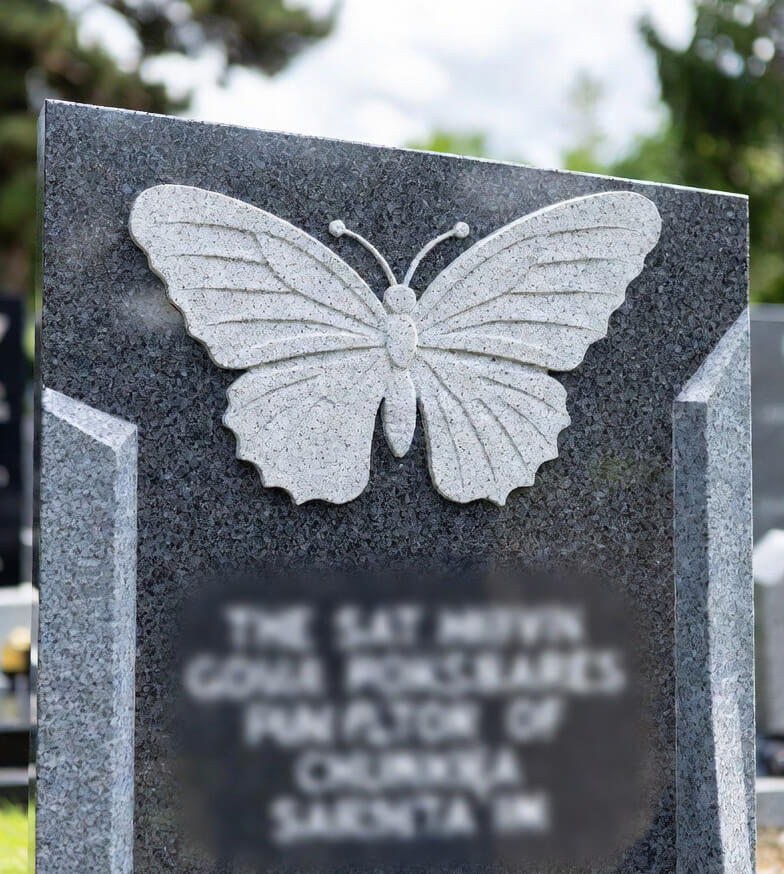
Common abbreviations often seen on gravestones featuring butterfly symbols include:
• I.L.M. — In Loving Memory
• R.I.P. — Rest In Peace
7. Final Thoughts
A butterfly on a headstone is a very touching human gesture in a graveyard. It communicates that the family did not want to believe that their loved one was simply gone. Throughout ages and across cultures, people have used this delicate creature as a symbol to convey the things that words fail to express, that life goes on, the soul is at liberty, and love survives even after death.
If you see this symbol on a Roman tomb or a modern one, the butterfly offers the same comforting message in a low voice to those who want to hear it.
In short: Placing a butterfly on a headstone symbolizes the resurrection, change, hope, and the everlasting nature of the soul, a message etched into stone for the grieving.