
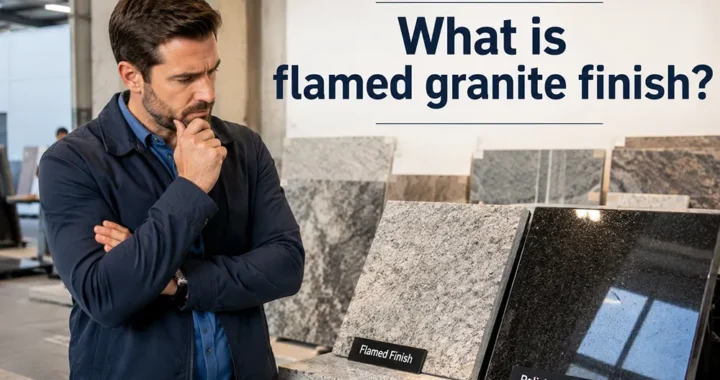
What Is Flamed Granite Finish?
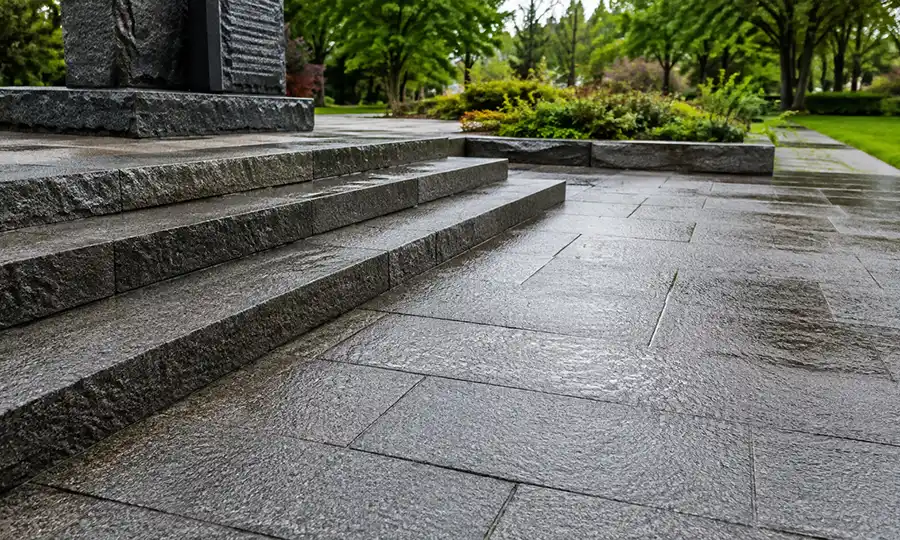
If you have ever walked across a granite plaza, outdoor stairway, garden path, or building entrance, there is a good chance you have already stepped on flamed granite.
In the stone industry, especially in Chinese granite factories, flamed finish is one of the most common treatments for outdoor stone. We use it almost every week for paving, steps, kerbs, landscaping stone, and some cemetery projects.
But many buyers still ask the same question:
What exactly is a flamed granite finish?
The simple answer is that the surface of granite is treated with a very hot flame. The sudden heat makes small mineral particles on the stone surface expand and break away. After that, the granite becomes rough, matt, and more suitable for outdoor use.
It sounds simple, but the final result depends a lot on the stone and the worker.
How Is Flamed Granite Made?
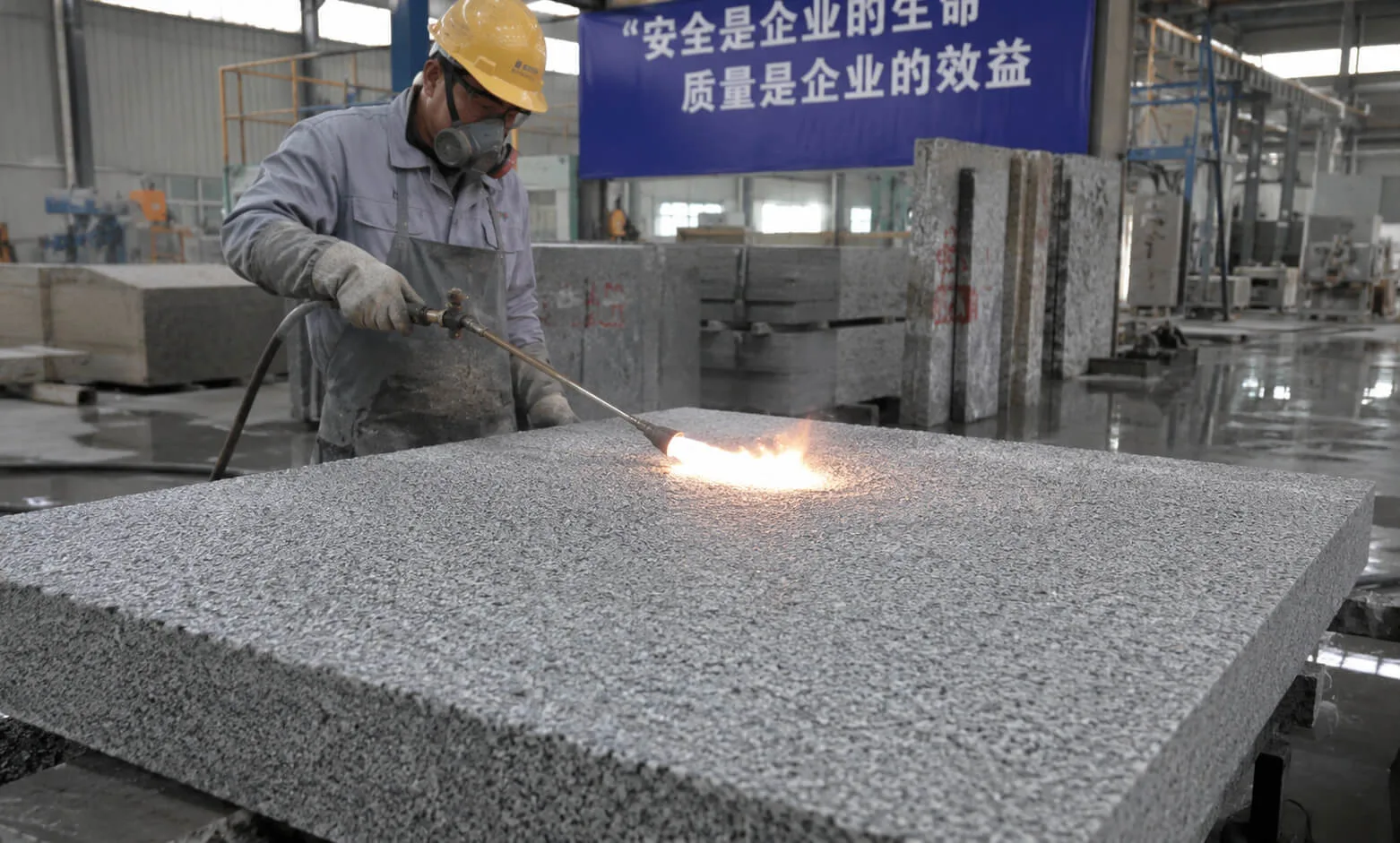
In a normal Chinese stone factory, granite slabs are first cut to the required size and thickness. After cutting, the slab passes through a flaming machine.
The flame can reach temperatures above 1,000°C.
Granite contains quartz, feldspar, mica, and other minerals. These minerals do not react to heat in exactly the same way. Because of this, the surface opens up and becomes textured.
We often describe it as the stone becoming a little “rougher and more alive.”
The machine speed is important.
If the flame passes too quickly, the finish may look too light. If it stays too long in one area, the surface can become uneven or even develop small cracks.
That is why experienced workers still matter, even when using modern equipment..
What Does Flamed Granite Look Like?
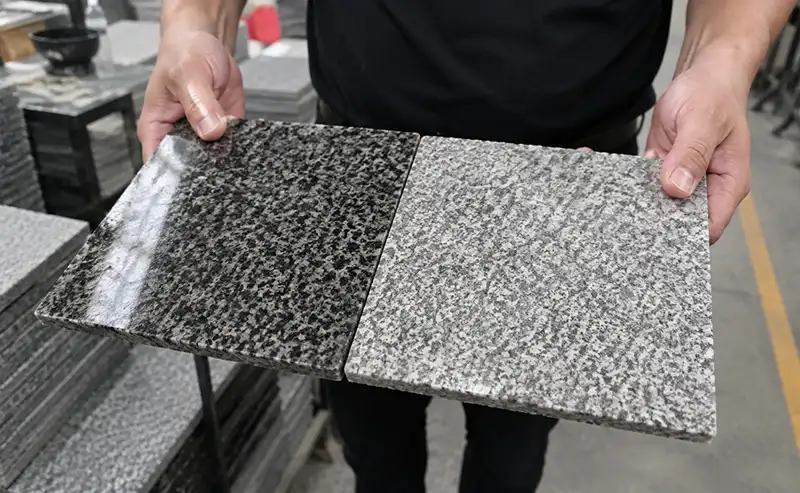
Compared with polished granite, flamed granite looks much more natural.
A polished surface is smooth, shiny, and reflects light. A flamed surface is rough, matt, and usually looks lighter in colour.
This surprises some customers.
For example, G654 granite can look quite dark when polished. Once it is flamed, it may turn into a softer medium grey.
We once had a buyer who thought we had used the wrong granite because his flamed sample looked much lighter than the polished sample he chose earlier.
We placed the two samples next to each other.
Same stone. Same block.
Only the finish was different.
That small example shows why physical samples are important. A photo on WhatsApp or email helps, but it does not always show the real texture and colour.
Why Is Flamed Granite Popular for Outdoor Projects?
The main reason is simple: better grip.
Polished granite can become slippery after rain. Flamed granite has a rough surface, so it is usually a better choice for areas where people walk.
Common uses include:
- Outdoor paving
- Garden paths
- Public squares
- Steps
- Pool surrounds
- Building entrances
- Kerbs
- Cemetery walkways
For commercial jobs, some clients also request slip-resistance testing based on ASTM, DIN, or other local standards.
It is worth saying that “flamed” does not automatically mean “completely non-slip.”
Real slip resistance depends on the stone type, surface roughness, water, dust, installation angle, and later maintenance.
So for a large public project, testing is still better than guessing.
Flamed Granite vs Polished Granite
The two finishes are very different in both look and use.
Polished granite is often used indoors because it shows the colour and grain of the stone more clearly. You often see it on countertops, walls, floors, and decorative pieces.
Flamed granite is more common outdoors.
Sometimes we also make one product with two finishes.
For example, a granite step may have a flamed top surface for grip, while the front face is polished for appearance.
This kind of combination is quite common in export projects.
Can Every Granite Be Flamed?
Not always.
Most hard granites can be flamed, but different materials react differently to heat.
G603, G654, G682, G684, and many other common granites usually work well.
But some stones may have natural cracks, softer mineral areas, or an inconsistant grain structure. Strong heat may cause these materials to flake or crack.
Thickness also matters.
A 20 mm tile does not react in the same way as a 50 mm step.
This is why we prefer to test the actual stone before running a big order.
A small test can avoid a very expensive problm later.
What Should Buyers Check Before Ordering?
If you are buying flamed granite from China, do not only compare the price per sqm.
Check the surface texture, colour range, thickness tolerance, edge finish, packing, and stone source.
For factory production, QC should inspect the surface during processing, not only after everything is packed.
Workers also need proper PPE because flaming involves high heat, gas, noise, and stone dust.
From our experiance, one of the most common mistakes is approving polished samples but ordering flamed material without checking the real finish.
It can cause unnecessary confusion.
Is Flamed Granite Easy to Maintain?
In most cases, yes.
Regular water cleaning and a neutral stone cleaner are enough.
Because the surface is rough, it can collect more dirt than polished granite. Oil and dark stains may also enter the open texture more easly.
For some outdoor projects, a suitable sealer can help.
But the sealer should be tested first. Some products may slightly change the colour or reduce surface grip.
This part is sometimes forgoten during installation.
Final Thoughts
Flamed granite is one of those finishes that looks simple but still needs good material, good machinery, and good workers.
From a Chinese stone factory point of view, it is practical, durable, and very common for outdoor work.
The most important advice is simple:
Always check a real flamed sample before mass producion.
Do not judge the stone only from a polished piece.
Check the texture, colour, thickness, and finish first.
A small sample costs very little compared with fixing a full container of stone after it arrives.
And in stone business, avoiding that kind of mistake is usually more valuable than saving a few dollars per square metre.