
Table of Contents
Introduction
Have you ever wondered why some people are buried directly in the earth without a casket? This practice isn’t about cutting costs or being unconventional—it’s deeply rooted in religious beliefs that have existed for thousands of years. Two major world religions, Islam and Judaism, traditionally require burial without caskets, and their reasons are both spiritual and practical.
Islamic Burial Practices
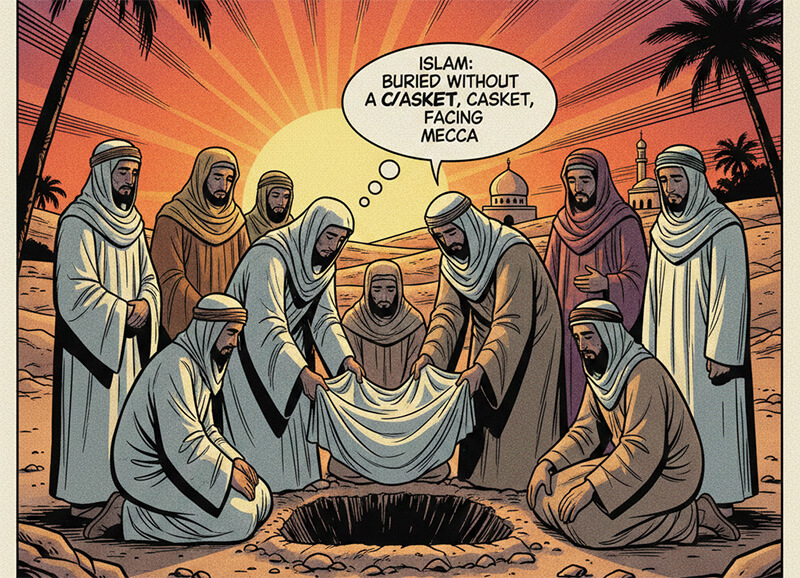
In Islam, burying the deceased without a casket is considered the most respectful and humble way to return a person to Allah. According to Islamic law (Sharia), the body should be washed, wrapped in a simple white cloth called a kafan, and placed directly into the earth. This practice emphasizes equality—whether you’re rich or poor, everyone faces death the same way.
The Quran teaches that humans came from dust and will return to dust. Using a casket is seen as creating an unnecessary barrier between the body and the earth. However, in Western countries like the U.S., UK, and Canada, where local laws sometimes require caskets or burial vaults, Muslims may use simple wooden boxes that allow the body to touch the soil through openings in the bottom.
Key facts:
- Islamic burials must occur within 24 hrs of death when possible
- Approx. 1.8 billion Muslims worldwide follow these practices
- The body is positioned facing Mecca (the holy city in Saudi Arabia)
- Cremation is strictly forbidden in Islam
Jewish Burial Tradition
Judaism shares similar beliefs about casket-free burials, particularly in Orthodox and Conservative Jewish communities. The Torah teaches “from dust you came and to dust you shall return” (Genesis 3:19). Traditional Jewish law requires burial in the ground, ideally without anything separating the body from the earth.
In Israel and some other countries, Jewish burials often involve wrapping the body in a tallit (prayer shawl) and placing it directly in the ground. When caskets are used due to local regulations, they’re typically made of plain pine wood with no metal parts—nothing that would slow natural decomposition.
Important details:
- Jewish burials should happen within 24-48 hrs after death
- Embalming is generally prohibited in Jewish law
- Approx. 15 million Jews worldwide observe various burial customs
- Even wealthy individuals are buried simply to maintain equality
A Real-Life Example
When journalist and author Christopher Hitchens researched religious practices for his book “God Is Not Great,” he interviewed Rabbi David Wolpe from Los Angeles. Rabbi Wolpe explained his own family’s experience: when his grandmother passed away in Jerusalem, she was buried within hours according to Jewish tradition, wrapped only in her shroud and placed directly in the rocky soil of the Mount of Olives cemetery.
“There was something profoundly moving about it,“ Rabbi Wolpe recalled. “No expensive casket, no elaborate funeral home preparations—just a simple return to the earth surrounded by family reciting prayers. It reminded us that death is natural, not something to be hidden behind layers of wood and metal.“
This experience isn’t unique. Across the U.S., there are now dozens of Jewish and Muslim cemeteries that accommodate traditional burials, working within state and local regulations while honoring religious requirements.
Environmental Benefits
Beyond religious significance, casket-free burials offer environmental advantages that resonate with modern ecological concerns. Traditional American funerals use approx. 30 million board feet of hardwood, 90,000 tons of steel, and 1.6 million tons of concrete for vaults annually, according to the Green Burial Council.
Natural burials without caskets:
- Allow bodies to decompose naturally within 10-25 yrs vs. 50+ yrs in sealed caskets
- Don’t introduce chemicals like formaldehyde into the soil
- Reduce carbon emissions from manufacturing and transportation
- Cost significantly less (avg. $2,000-4,000 vs. $7,000-12,000 for conventional burials)
These eco-friendly aspects have sparked interest in “green burials” even among non-religious people in countries like the U.S., Australia, and throughout the EU.
Conclusion
Burial without a casket is primarily practiced by Muslims and Jews, rooted in ancient scriptures and beliefs about humility, equality, and returning to the earth. What started as religious obligation has proven to be environmentally sustainable and increasingly relevant in our modern world. Whether motivated by faith, ecology, or both, this practice reminds us that sometimes the simplest approach is the most meaningful.
As our global society becomes more diverse and environmentally conscious, understanding these traditions helps us appreciate different perspectives on life’s final journey. After all, regardless of our beliefs, we all share the same earth—and to it, we all eventually return.