
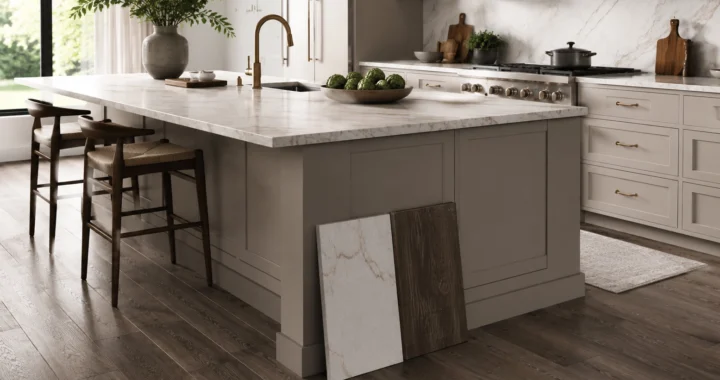
Choosing a countertop color sounds easy until real life gets involved. You bring home a few samples. You place them on the cabinet. Then you look down at the floor and feel stuck. The white stone looks clean. The black stone looks rich. The beige one feels safe. Then one question comes up: should the countertop be lighter or darker than the floor?
The honest answer is this: both can work. A countertop doesn’t have to follow one design rule. It has to fit the room, the light, the cabinets, and the people who live there.
A kitchen is not just a photo for a magazine. It’s where coffee spills, children ask for snacks, friends gather, and someone stands at the counter after a long day. So the best color choice should feel good, not just look good.
This article explains when to choose a lighter countertop, when a darker countertop works better, and how undertones, cabinets, lighting, materials, and daily life affect the final decision.
Start With the Feeling You Want
Before you choose light or dark, think about the mood of the kitchen.
A lighter countertop can make a kitchen feel clean, open, and calm. White quartz, cream marble, pale granite, and light porcelain are common choices for this look. They can help a small room feel less crowded. Light colors reflect more light, so they can make a kitchen feel brighter.
A darker countertop can make a kitchen feel grounded, warm, and rich. Black granite, dark quartz, soapstone, and deep gray stone can give the room strength. Dark counters can also create a strong focal point, which helps in an open-plan home.
So the question isn’t only about color. It’s about emotion. Do you want the kitchen to feel fresh and open? Or do you want it to feel deep and cozy?
When a Lighter Countertop Makes Sense
If a floor is dark, then a lighter countertop is a good choice. For example, when the floor is walnut, dark tile, or deep brown wood, a light-colored countertop can help to soften the overall look. It also prevents the room from becoming overbearing.
Besides that, this combination can make the kitchen feel more practical and easier to live with. Often older houses have very narrow kitchens with only a few windows letting in light. In that situation, a dark floor and dark counter might make the room appear quite small.A light counter can give the eye a place to rest.
As an illustration, Sarah and Mark purchased a small property with brown floor tile. They were interested in bold kitchens, so initially, they explored black stone countertops. But after placing a black sample on the cabinet, the room felt even smaller. Their interior designer suggested warm white quartz with soft beige veins. The kitchen retained its uniqueness but gave a more spacious impression. Sarah commented, “I didn’t want an icy white kitchen. I wanted a kitchen where the children would enjoy eating breakfast and where I would love spending time.”
That’s what a lighter countertop can do: it softens a strong floor.
Additionally, if a light counter is veined, specked, or has natural movement, it can conceal some wear and tear of everyday life quite well. A simple white surface tends to show marks quite easily, but a pretty patterned light stone can camouflage crumbs and water marks.
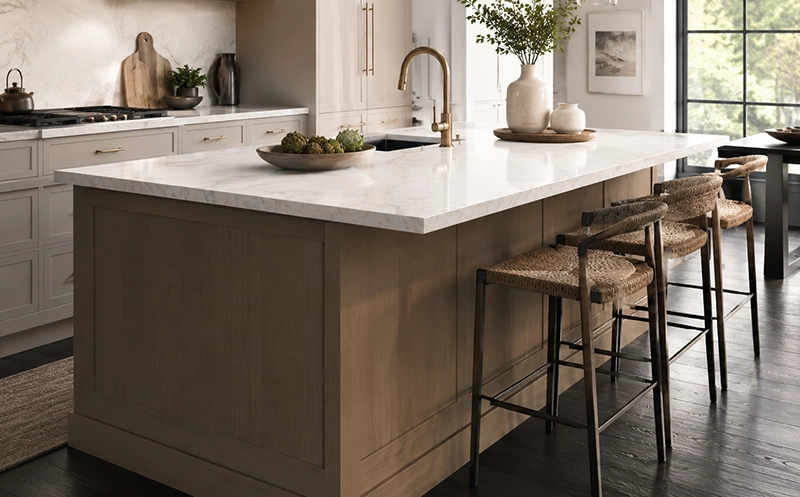
When a Darker Countertop Might Be the Better Choice
A dark countertop is often a great match with a light floor. For example, white oak flooring can pair well with black granite, and beige tile can work with deep charcoal quartz. The high contrast is what gives the kitchen a certain character.
Going for a dark surface is another good idea if the rest of the kitchen is white or cream colored. This will create a visual line that goes all the way around the room and immediately defines the work area. It could come in handy if the kitchen is really big because when everything is light colored it just looks very flat and uninteresting.
Take, for instance, James. He is a retired chef, and for him it was the kitchen’s functionality that mattered, not its perfection. His house featured light oak floors with white prison-like simple cabinets. He went for a matte black stone countertop.It showed some fingerprints, but he was not too worried about them. He said, “I cook here. It’s not like I expect it to look like no one has ever touched it.”For him, the darker surface gave the kitchen a sense of authenticity.
You should be aware that dark countertops require fairly strong lighting. That’s because they can highlight things like flour, dust, or water droplets. Besides, they tend to soak up light. If the room does not have many windows, install under-cabinet lighting, choose light-colored walls, or use a very light backsplash. So, dark countertops are a real eye-catcher, just make sure they have enough light around them.
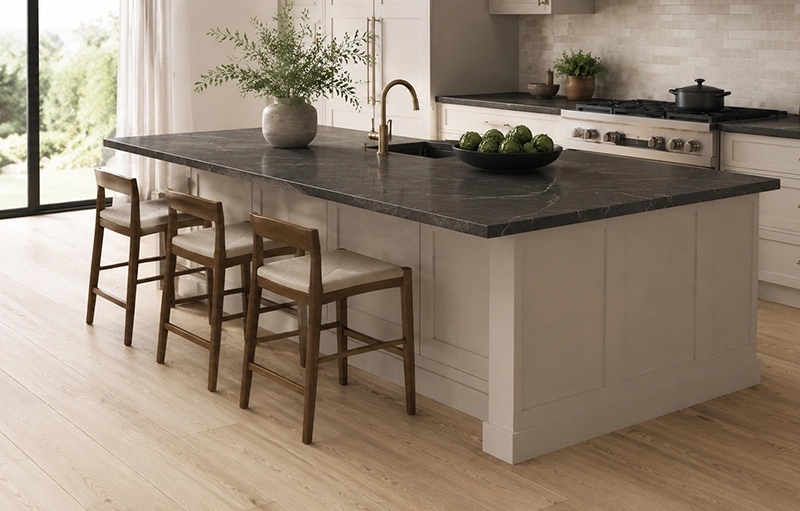
Match Undertones, Not Just Colors
One mistake homeowners make is matching only the surface color. They see a beige floor and choose a beige countertop. But the two beige tones may not match.
Every material has an undertone. Some whites feel cool. Some creams feel warm. Some gray floors have blue tones. Some brown floors have red or yellow tones.
A warm floor works well with cream, beige, brown, gold, and warm white countertops. A cool gray floor works better with crisp white, charcoal, soft gray, or blue-gray stone. Natural wood can work with many counters, but the veins in the countertop should connect with the wood tone.
This step creates separation and harmony at the same time. The floor and countertop do not need to match. They need to speak the same design language.
Bring samples home before you buy. Look at them in morning light, afternoon light, and evening light. A stone that looks perfect in a showroom can look too yellow or too cold in your own kitchen. This can prevent a costly mistake.
Let the Cabinets Be a Second Helping
The cabinets sit between the countertop and the floor, so they play an important role. They can either connect the two surfaces or make the whole room feel disjointed.
In case your floors as well as cabinets are dark, go for a lighter countertop in order to create a feeling of openness in the room. On the contrary, if your floors and cabinets are light, then a darker countertop may be the way to go for a bit of contrast. If the cabinets are wood, choose a countertop that picks up one tone from the wood grain.
One common approach is to let one surface become the star of the room. The floor, cabinets, and countertop should not all compete for attention at the same time. So if the floor is heavily grained, pick a counter that is simpler. On the other hand, if the countertop has strongly colored veins, opt for a less noisy floor.
A good design requires a sense of balance. Too much contrast can come across as somewhat aggressive. On the other hand, too little contrast may feel dull.
Think of Real Life
A kitchen should serve the people who use it every day. For example, A family with children might want a countertop that hides crumbs and a floor that camouflages scratches. On the contrary, a cooking couple who spend the evenings preparing meals would probably pay attention to proper lighting and cleaning. A homeowner who likes calm spaces might choose soft stone paired with natural wood flooring.
Material is of great importance, too. Quartz is a popular choice because it is nonporous and easy to clean. Granite is very durable and heat resistant, however, it may require sealing in order to keep its properties. Marble is a visually amazing material but is very prone to stains and scratches. Porcelain and sintered stone are highly durable and can be found in various colors. The finish makes a big difference in the appearance, too. Polished stone reflects light well. Meanwhile, honed stones are softer and less formal in appearance.
Final Answer
Therefore, when it comes to deciding whether a countertop should be lighter or darker than the floor, the decision depends on the overall look and feel you want in your kitchen.
If you have a dark floor and want to open up the kitchen space or brighten it, then a lighter countertop is the way to go.
If your floor is light, your room has enough natural light, and you want a dramatic, grounded look, a darker countertop can be suitable.
There is no one-size-fits-all approach. A countertop and a floor are like two dance partners. They should not be required to match, nor should they be forced to compete. They need contrast, shared undertones, and a feeling that suits your home.
Ultimately, the right choice is personal. It comes from how you feel when you walk into your kitchen.