
What Is Sandblasting on a Headstone?
When families choose a memorial, they often pay attention to the stone, the shape, and the words that will stay there for many yrs. One detail that many people never think about is how those words are actually carved. That leads to a common question: What is sandblasting on a headstone?
Sandblasting is one of the most common methods used to carve names, dates, symbols, and artwork into granite and some other types of memorial stone. Instead of using hand chisels, the process uses high-pressure abrasive material to remove part of the stone surface and create deep, lasting letters.
Although the technology sounds industrial, its purpose is deeply human. It helps preserve a family’s memories for generations.
How Does Sandblasting Work?
The process begins with a polished stone. A rubber stencil is applied to the surface, and the design is cut into the stencil using a computer-controlled plotter or by hand.
The exposed areas become the parts that will be engraved.
Next, compressed air pushes abrasive particles—most commonly aluminum oxide or other approved media—through a blasting nozzle at very high speed. These particles strike the stone and gradually remove its surface. The protected areas stay untouched while the exposed sections become recessed.
After blasting is complete, the stencil is removed, the stone is cleaned, and any finishing work is completed.
Today, many monument workshops combine CAD drawings, CNC cutting equipment, and sandblasting to produce consistent lettering while still allowing room for custom artwork.

Why Is Sandblasting So Popular?
Granite is one of the hardest natural stones available. According to the Mohs Hardness Scale, granite typically measures between 6 and 7, making it difficult to carve by hand. Sandblasting provides an efficient solution while producing clean, sharp lettering.
The National Park Service (NPS) notes that granite has become one of the most durable materials for cemetery monuments because of its strength and resistance to weathering. Deep-cut inscriptions created by sandblasting usually remain readable for many decades under normal conditions.
Another advantage is flexibility.
A memorial can include:
- Family names
- Birth and death dates
- Religious symbols
- Military emblems
- Floral patterns
- Portrait outlines
- Custom artwork
All of these can be produced with remarkable consistancy through sandblasting.
A Family’s Experience
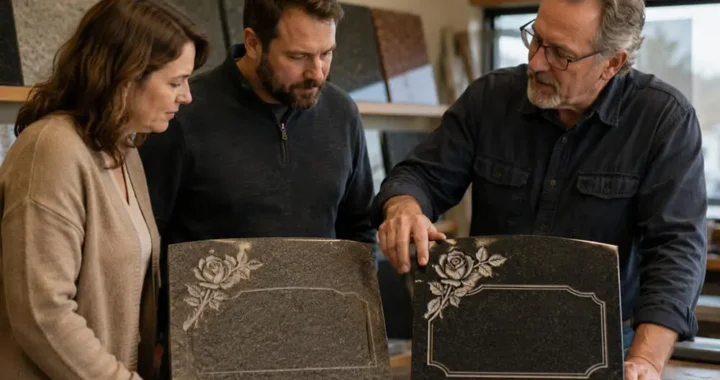
After losing their father, Michael and his sister Emma visited several memorial companies.
One company showed hand-carved lettering. Another recommended sandblasting.
Emma worried that machine work would look cold.
The memorial craftsman placed two granite samples on the table. One had shallow hand-cut letters. The other had deeply sandblasted lettering.
He invited them outside into bright sunlight.
The hand-cut sample became difficult to read from several meters away. The sandblasted letters stayed clear because their depth created natural shadows.
Michael smiled and said, “Dad always liked things that lasted.”
Emma nodded.
“We’re not buying a stone for today,” she said. “We’re buying something our grandchildren can still read.”
That simple demonstration helped them make their decision.
Is Sandblasting Better Than Laser Etching?
The answer depends on the design.
Sandblasting is usually preferred for deep lettering, crosses, borders, and large decorative carvings. It creates depth that remains visible after many years.
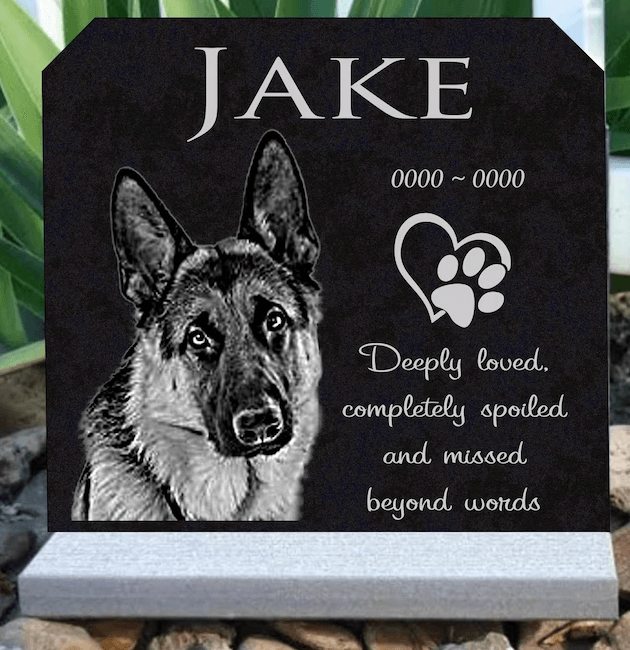
Laser etching works differently. Instead of removing large amounts of stone, the laser changes the surface color. It is most commonly used on polished black granite for photographs, landscapes, and detailed portraits.
Many modern memorials combine both methods.
For example:
- Sandblasted family names
- Laser-etched portrait
- Sandblasted flowers
- Laser-etched background scenery
Using both techniques allows families to create a memorial that balances durability with artistic detail.
Does Sandblasting Damage the Stone?
When performed by experienced professionals, the answer is no.
The stencil protects the surrounding surface, while the abrasive material only removes the exposed sections. Professional monument companies carefully control blasting pressure, nozzle distance, and engraving depth.
Problems usually occur when equipment is poorly adjusted or when inexperianced operators use excessive pressure. This can create rough edges, uneven depth, or damaged polish.
That is why choosing an experienced memorial manufacturer matters as much as choosing the stone itself.
Why Families Still Choose Sandblasting
Technology has changed monument production over the past few decades, but sandblasting remains the industry standard for lettering on granite headstones.
The process creates deep inscriptions that resist weathering, improve readability, and provide lasting beauty.
Many workshops now combine computer design with skilled finishing by experienced craftsmen. Machines improve accuracy, while people provide judgement, care, and attention to detail.
That combination gives families confidence that every name, date, and symbol reflects the person being remembered.
Final Answer
So, what is sandblasting on a headstone?
It is a monument engraving process that uses high-pressure abrasive material to carve permanent letters and artwork into stone. It is one of the most reliable methods for granite memorials because it produces deep, durable inscriptions that remain legible for many decades.
A headstone is more than stone. It carries a family’s history, love, and remembrance. Sandblasting simply provides the tool that helps those memories stay visible long after today’s generation is gone.
Even the finest equipmant cannot replace human care. Behind every finished memorial are designers, craftsmen, and families working together to create something that will continue telling a story for many generations to come.