
UK Headstone Installation Guide
Complete Legal Requirements and Regulations
📋 Table of Contents
Introduction
When a loved one passes away, deciding on a tombstone becomes a very important way to remember that individual. Unfortunately in the UK, you cannot just place an arbitrary headstone on any grave in a cemetery. There are strict legal rules pertaining to them. These rules exist in order to maintain cemeteries safe, dignified, and well-maintained locations for everyone.
The laws on headstone installation can seem confusing at first. Most of these differ depending on the cemetery. Established church graveyards follow one set of guidelines while council cemeteries follow another. This article will walk you through what is needed prior to placing a headstone over a grave in the UK.
Granting Approval for Your Headstone
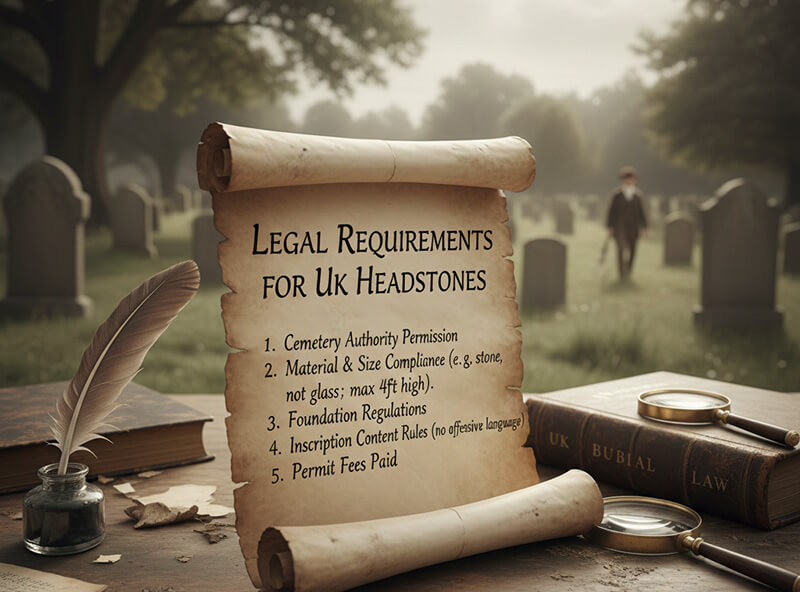
Before placing of a headstone, one should apply for permission from the cemetery or the churchyard. Such is law in the UK; one cannot simply pay for a headstone and place it on a grave without approval.
It is about who owns the grave: If you own the ERoB (Exclusive Right of Burial) for the plot, you have the right to place a memorial. Without these rights, you will have to get the permission of whoever holds them.
In cases such as that of church graveyards, what you would require is called a faculty. A faculty is the special permission from the church body. The local vicar along with the church council PCC will get a chance to discuss your application. They will have a look at your proposed headstone design and decide as to what accords with the character of the churchyard.
📌 Actual Example: A family in Yorkshire asked in 2018 to install a bright pink headstone decorated with cartoon characters for their little daughter. However, the church turned down the request because the design did not comply with the historic, traditional style of the churchyard. The family was thus forced into taking another more traditional design that might preserve the memory of their child.
For council-run cemeteries, the process is, however, different. You apply to the local authority or cemetery office. They have their own set of regulations. Most councils provide a form you must complete. This form inquires about the headstone size, material, and design.
📊 Fact: As stated by the ICCM (Institute of Cemetery and Crematorium Management) in a study published in 2022, around 85% of all applications for headstones placed in UK cemeteries are approved after first submission. The other 15% need amendments before getting their approvals.
Size and Height Regulations
Every cemetery has rules as regards the height of a headstone. These rules are meant practically and safely to deal with these things. A taller headstone might bow over and rest on someone, while a wider memorial might consume space reserved for other plots.
Most general guidelines are as follows among the UK cemeteries:
- Height: 2-4 feet tall
- Width: 1.5-3 feet wide
- Thickness: 3-6 inches thick
These measurements can vary from one cemetery to another. Some historic churchyards approve only smaller memorials to protect the site’s character; larger monuments might be allowed in certain sections of new cemeteries.
📌 Actual Example: The graveyard of St. Mary’s Church, in Cornwall, is already over 500 years old. They, therefore, require that headstone height to 3 feet since any taller stones would block the view of the historic church building. A particular family learned this when they found out that their order of a 5-foot memorial had to be returned for a smaller one, which cost them money and delayed installation by two months.
The size rules also vary depending on the type of grave. A single grave has a smaller headstone than a family plot. If you purchased a double plot, you may be allowed to install a larger memorial covering both spaces.
📊 Evidence: The Church of England 2023 states lawn-style headstones not to be higher than 3 feet 6 inches and 3 feet in width. These rules apply to over 16,000 Church of England burial grounds across the country.
Material and Safety Standards
The material selected for a headstone must comply with safety standards.The standards … are set out in BS 8415. This is the recognized British Standard for the safety of memorials.
BS 8415 says that headstones must resist wind and weather without collapse. The stone must be suitably thick and heavy to provide stability. The depth of the foundation must be adequate to support the weight.
Commonly accepted materials:
- Granite (most commonly used)
- Marble
- Limestone
- Slate
- Sandstone
In some cemeteries, some materials may not be allowed. Plastic, wood, or composite materials may not be sufficiently durable. The material must last for many years without breaking down or becoming a reasonable hazard.
⚠️ Safety Data: Between 2000 and 2010, the fall of some old headstones led to deaths in the UK. These tragic incidents led to a clampdown on safety inspections: Headstones are, nowadays, to be evaluated in terms of their stability by cemetery managers. For a memorial that fails the test, it gets laid flat until it can be repaired or replaced.
📌 In Practice: A Manchester cemetery tested 8,000 headstones for safety in 2015. It was subsequently found that 1,200 memorials (15%) had failed the stability test. The cemetery reached out to the families and asked them to pay for repairs. Those families who could not pay for repairs had the headstone concerned immediately laid down; this was seen to be a distressing event for the many relatives wishing to have their loved one’s memorial upright.
He must provide a certificate when ordering the headstone. This certificate will prove that the memorial conforms to BS 8415. The cemetery will not allow installation without this document.
Design and Inscription Limitations
The design cannot contradict the cemetery regulations. Some cemeteries accept experimental designs, including pictures, symbols, and unusual shapes. Others allow just straight rectangular stones with plain text.
Church graveyards tend to have the strictest design limitations. The Church of England expects the traditional designs to match the historic character of the churchyard and prefers Christian symbols like crosses, angels, or doves.
Cemeteries often limit the following:
- Photographs or images on the stone
- Bright colors or painted designs
- Non-religious symbols
- Unusual shapes
- Glass, mirrors, or shiny decorations
The wording put on the headstone will also get approval and are most often approved to include the person’s name, birth date, death date, and a short message. However, some phrases or quotations might not be permitted.
📌 For Example: In Devon, a family arranged a football team logo on their father’s headstone. Because of this love of the sport, the church denied this request, saying that sporting symbols could not be used on sacred ground. The family compromised by asking that the words “Forever a fan” be inscribed instead of the actual logo, thus honoring their father’s passion while following the church’s rules.
Unlike church graveyards, council cemeteries have more flexible design rules. They may allow photographs, colored glass, any modern design, etc., but all memorials are subject to approval in order to keep respectability.
📊 Evidence: According to a survey done in 2021 by the Ministry of Justice, those design-related denials make up some 30% of all rejected headstone applications at the church graveyards. And in council cemeteries, the design denials drop to 8%.
Installation Specifications
Most of the UK cemeteries do not allow individual installation of a headstone. It is mandatory to be done by specialists because an improper installation can result in dangerous situations.
The memorial mason is the one who is qualified to do the installation. They are supposed to have proper insurance coverage and the appropriate training. The BRAMM (British Register of Accredited Memorial Masons) holds a list of these professionals.
The installation process:
- Excavation of a foundation hole by the mason
- Concrete pouring for a secure base
- Curing of Concrete
- Headstone attachment to the foundation
- Testing memorial for stability
- The cleaning up of the grave site
Most times, the cemetery has regulations on when the installation can take place. For instance, before fixing a headstone, some cemeteries require a wait of six months after burial. Such a period is meant to enable the earth to settle. In case you fit in a memorial before time, the ground may shift and make the stone unstable.
📌 Real Case Example: One woman in Liverpool ordered her husband’s tombstone shortly after his death. She was not aware of the six-month waiting period. When she went to schedule the installation after three months, she was denied by the cemetery. Long story short, she had to wait for another three months. During that period, the grave had only a temporary marker—most disappointing to her since it didn’t seem to do justice to her late husband’s memory.
📊 Industry Statistics: The NAMM (National Association of Memorial Masons) states that properly taking care of a headstone takes between 4 to 6 hours. Almost 70% of the problems regarding headstone stability in the first five years of its presence are associated with rush jobs or improper techniques.
After installation, the cemetery inspector must approve the work. Their work includes checking whether the memorial complies with safety rules as well as site placement. If anything was found wrong, it would be up to the mason to fix it before final approval from the cemetery is given.

Costs and Fees
Asserting a headstone in a UK cemetery comes with a cost attached. The costs usually revolve around several areas, which can aid in planning for the budget.
Main costs breakdown:
- The headstone alone: £800 to £3,000
- Inscription (words carved): £100 to £300
- Install by a mason: £200 to £500
- Cemetery permission fee: £50 to £300
- Foundation works: £150 to £400
The permission fee goes to the cemetery or church. This money covers processing costs incurred by your application and inspection of the memorial after its construction. Different cemeteries have different fees. Church graveyards might charge less than council cemeteries, or vice versa.
📊 Cost Evidence: In 2023, a report by the funeral industry has shown that the average total cost for a headstone in the UK (including stone, installation, and permission fees) ranges from £1,500 to £4,200. Costs may vary on regions, such as London where costs are 40% more than in the other parts of the country.
📌 Real Case Example: One family budgeted £1,000 for their mother and found a simple granite memorial for £900, only to realize that they had not factored in the installation fee (£350), the cemetery fee (£150), or the inscription cost (£200). Their total bill came to £1,600, which put financial strain on the family. They wished they had known all the costs from the start.
Some cemeteries have a few features that attract additional costs. For example, a selfie on the stone attracts extra costs, and custom shapes or unusual materials increase the price. Be sure to get a complete price list before placing an order for your memorial.
Remember to always check with your specific cemetery or churchyard for their individual regulations, as requirements can vary significantly across the UK.